
The herald of the 58th Cocido Fair argues that this Festival of International Tourist Interest "is much more than a dish; it is a lesson in time and wisdom‘ because ’there is a philosophy of life in this way of cooking‘. He points out that ’cocido, like medicine, teaches us that true value lies in the process and not only in the final result, and that paying attention to detail is a form of respect".
He refers to Cunqueiro and his work ‘La cocina gallega’ (Galician cuisine), in which he points out that ‘cuisine is the landscape put into a pot’ and emphasises that, as the first herald of the Fair, ‘dishes such as cocido ceased to be just food and became a story, an identity and a shared heritage’.
He had a special message for young people, telling them that they should dare to think differently and open their minds, without losing their roots and values.
He reminded everyone who makes the festival possible and ‘who are not always seen: producers, cooks, associations, volunteers, municipal workers and neighbours’, saying ‘you are the true soul of Cocido’.
He explained that his Foundation was born out of an ethical commitment to understand that health should not depend on where one is born or the resources one has.
He concluded by saying that ‘no matter how much one travels the world and meets many people, the heart always knows where home is, and today I feel at home.’
Nine new Commanders were appointed: Diego González Rivas, Irene Villa, Ramiro Mejuto, Luis de la Fuente, Jorge Mira, Almudena Maíllo, Antonio Chaves, María Martínez Allegue and Valentín García.
The 58th Cocido Fair includes the celebration of the first macro-cocido at the Lalín Arena, the presentation of Cocido in New York on 26 April, a Traditional Pig Slaughter carried out for the first time by a group of parishes, and a Cocido Gala with a new format. For future editions, the declaration of Galician cocido as Ben de Interés Cultural (Ben of Cultural Interest) in the category of intangible heritage will be promoted.
"It is an immense honour for me to be here today, in this place that is not just a point on the map, but a space full of meaning, memory and identity. Thank you to the Lalín City Council for inviting me to share this special moment with you, for allowing me to be part of a celebration that represents, like few others, who we are as a people. The Cocido Fair is not just a festival. It is a collective expression, a declaration of pride and a way of telling the world who we are and how we understand life." With these words, the world-renowned Galician surgeon Diego González Rivas began his speech at the 58th Cocido Fair.
González Rivas continued with a reference to the values that identify us as Lalín residents and as Galicians: "It is often said that Lalín is the Kilometre Zero of Galicia. And this is not an empty phrase. This is where paths, stories and generations converge. This is where values that we identify as deeply Galician are preserved: hard work, humility, perseverance, respect for a job well done, principles that also guide my daily work.‘ He added: ’Lalín represents the Galicia that does not need to raise its voice to be noticed. The Galicia that builds day by day, with perseverance, slowly but surely."
He went on to argue that ‘Cocido de Lalín is much more than a dish; it is a lesson in time and wisdom. There are meats that need hours, vegetables that demand respect for the exact point of doneness, and a broth that is built up little by little, with patience and knowledge. Because cocido is not made in a hurry: it is made with discernment.’
Wisdom in pots simmering over a low heat and in the hands of those who learned by doing
In this regard, he emphasised that "as in medicine, it is necessary to listen, observe, wait and act at the right moment. Cocido teaches us that true value lies in the process, not just in the end result. That paying attention to detail is a form of respect and that wisdom is not always found in books, but also in home kitchens, in pots simmering on the stove and in the hands of those who learned by doing. And that — that relationship with time, patience and knowledge — is something deeply Galician. A way of being in the world that turns a humble dish into a symbol, and a shared meal into an act of celebration, encounter and belonging," she remarked.
Cocido represents family, tradition and affection
She shared a personal memory related to cocido. She explained that "in my house, cocido was not just food. It was an event. My grandmother made it, with that knowledge that is not learned in books, but in life. She knew when to start, when to wait and when everything was just right, without rushing and without exact measurements, only with the experience of years."
He went on to say that "as time went by, when she was no longer there, my aunts took over. And the stew remained the same: a reason to get together, to celebrate, to share a table and time. One of those days when the house was filled with conversation, laughter and family.‘ He maintained that: ’For me, the stew was always that: a moment of celebration, of togetherness and of memory. A reminder that the most important things in life often happen around a table, among people who love each other. And perhaps that is why this gastronomic festival moves me in a special way. Because when we celebrate Cocido de Lalín here, we are not just talking about an extraordinary dish, but about everything it represents: family, tradition and affection."
The table as a space for community
He explained that ‘around a table laden with food, we share not only food, but also stories, memories, silences and laughter. Families, friends and entire generations come together.’ In this regard, he pointed out that "in an increasingly fast-paced and individualistic world, this festival reminds us of the importance of coming together, of sharing time, of community. It reminds us that a strong society is built around human bonds."
A proclamation within a great tradition
He framed his proclamation within ‘a long tradition that deeply honours this festival. Throughout the history of the Lalín Cocido Fair, some of the most relevant voices in Galician and Spanish culture, literature and thought have passed through this podium.’ All the speakers, among whom he mentioned Álvaro Cunqueiro, Xosé Filgueira Valverde, Xosé Otero Abeledo ‘Laxeiro’, Celso Emilio Ferreiro, Eduardo Punset and Víctor Freixanes, ‘among many other names, contributed to making this festival more than just a gastronomic celebration: a true space for cultural and identity-building encounters’.
He stressed that ‘each of them brought here their voice, their vision and their way of understanding Galicia and the world. And that shows that Cocido de Lalín not only feeds the body, but also the mind, the collective memory and the pride of belonging to a land with extraordinary cultural wealth’.
Cooking as a form of memory: cocido as a story, identity and shared heritage
He referred to the first speaker at the Fair, Álvaro Cunqueiro, noting that ‘he highlighted Galician cuisine as a cultural, literary and even moral fact’ and said that "he reminded us that cooking is a way of telling who we are, of preserving memory and of respecting the time of things. Thanks to him, dishes such as stew ceased to be just food and became a story, an identity and a shared heritage."
He referred to Cunqueiro with a quote from his book ‘A cociña galega’ (Galician cuisine), in which he states that ‘cooking is the landscape put into a pot.’ ‘And in that landscape are our history, our time and our way of understanding life,’ emphasised the speaker.
I carry Galicia with me everywhere I go
He went on to explain that "throughout my professional life, I have had the opportunity to work in more than 140 countries. I have met extraordinary people, seen very different contexts and places where access to healthcare is a daily challenge. But in all those places, I carry Galicia with me. I carry it with me in the way I treat my patients, in the way I understand responsibility, in the humility with which any profession must be practised. Because no matter how many people you meet in the world, your heart always knows where it belongs."
Knowing the world to understand home
‘Travelling teaches me to learn, to adapt, to put things into perspective. But it also teaches me something essential: to value my roots,’ he said. ‘You can meet many people around the world, work on different continents, live realities far removed from our own. But there is one thing that never changes: the place where you learned who you are. And for me, that place has always been and always will be my homeland: Galicia.’
The Foundation: commitment to the world
Diego González Rivas explained that ‘my Foundation was also born out of this international experience. A Foundation that does not work in a specific territory, but wherever there is a need. In Africa, in Latin America, anywhere in the world where there are people without resources who need medical care.’
He emphasised that ‘its objective is not only to operate, but also to train local professionals, share knowledge and build capacity so that healthcare can be sustained over time. Because real help is not what arrives once a month, but what leaves tools for the future.’ ‘The Foundation was born out of an ethical commitment: to understand that health should not depend on where one is born or the resources one has,’ he remarked.
Galician values carried around the world
‘The Foundation does not work in Galicia, but it carries Galicia with it. It carries the values learned here: humanity, closeness and respect for the individual, solidarity without fanfare. That way of ours of helping without making noise, of working without seeking the limelight. Because being Galician is not just a geographical issue; it is a way of being in the world,’ he stressed.
Medicine as a human act
This international legend of medicine asserted that "medicine is not just technique and innovation (...) it is, above all, humanity. Each patient is a story, a family and a hope. And that cannot be learned only from books or in the most advanced operating theatres. It is also learned in life and through the values with which one grows up. Like stew, good medicine requires time, care and respect."
He argued that "Lalín is an example of how tradition and the future can go hand in hand. Here, we defend who we are, but we also invest in youth, talent, culture and innovation. A land that only looks to the past stagnates. A land that forgets its roots loses its soul. Lalín shows that it is possible to move forward without losing oneself."
Message to young people
He also had some special words for the young people of Lalín and Galicia, saying: ‘You are the present and, above all, the future of this land. Your talent, your creativity and your capacity for innovation are essential for Lalín, for Galicia, to continue moving forward without losing its identity.’
He told them: "Don't be afraid to think differently, to do things differently, to question what has always been done the same way. Progress comes precisely from this way of opening your mind, without ever forgetting the values learned here: effort, humility, respect and commitment to others.‘ (...) ’Because there is no better way to honour what we have received than to continue building here, with deep roots and our eyes set on tomorrow."
The true soul of the festival
González Rivas remembered all the people who make these festivities possible, ‘people who are not always seen: producers, cooks, associations, volunteers, municipal workers and neighbours.’ ‘You are the true soul of Cocido. For that, thank you very much,’ he said.
At the end of his speech, which he gave entirely in Galician, he defended ‘from Kilometre Zero in Galicia’ that ‘no matter how much one travels the world, no matter how many people one meets, the heart always knows where home is, and today I feel at home,’ before ending with cheers for the Cocido Fair, Lalín and Galicia.
Unique features of this edition
This Fair is also marked by the celebration, for the first time, of a macro-cocido in the Lalín Arena, which guaranteed that everyone who wanted to could enjoy our signature dish on the big day without leaving our town. It will be prepared by chefs Álex Iglesias and Carlos Brea, who make up the Gastrodeza company. This year was also the first time that the Traditional Pig Slaughter was organised by a parish area, in this case, the Vía de la Plata, made up of the parishes of Botos, La Retama, Vilanova and Donsión. The event was held on 25 January at the Mouriscade mansion.
The Cocido Gala on 30 January also debuted a new format, transforming into a musical and gastronomic festival that filled the Lalín Arena. This year, the Fair was presented in Santiago de Compostela, Oviedo, Madrid and, in April, in New York, consolidating the internationalisation of the festival and reinforcing its role as a gastronomic capital. In future editions, the declaration of Galician cocido as Ben de Interés Cultural (BIC) in the category of intangible heritage will be promoted.
In addition, the 58th Cocido Fair encompasses a whole series of events and activities, including the 28th Cocido Month, which, although it bears the name of a month, lasts for practically half a year; the 5th International Beekeeping Fair, Alvariza, which was held on 31st January and 1st February; and the main exhibition on cocido, “Antón Sobral: el silencio de la mar” (Antón Sobral: the silence of the sea), which can be seen at the Ramón Mª Aller Municipal Museum until 28th March.
Nine new Commanders
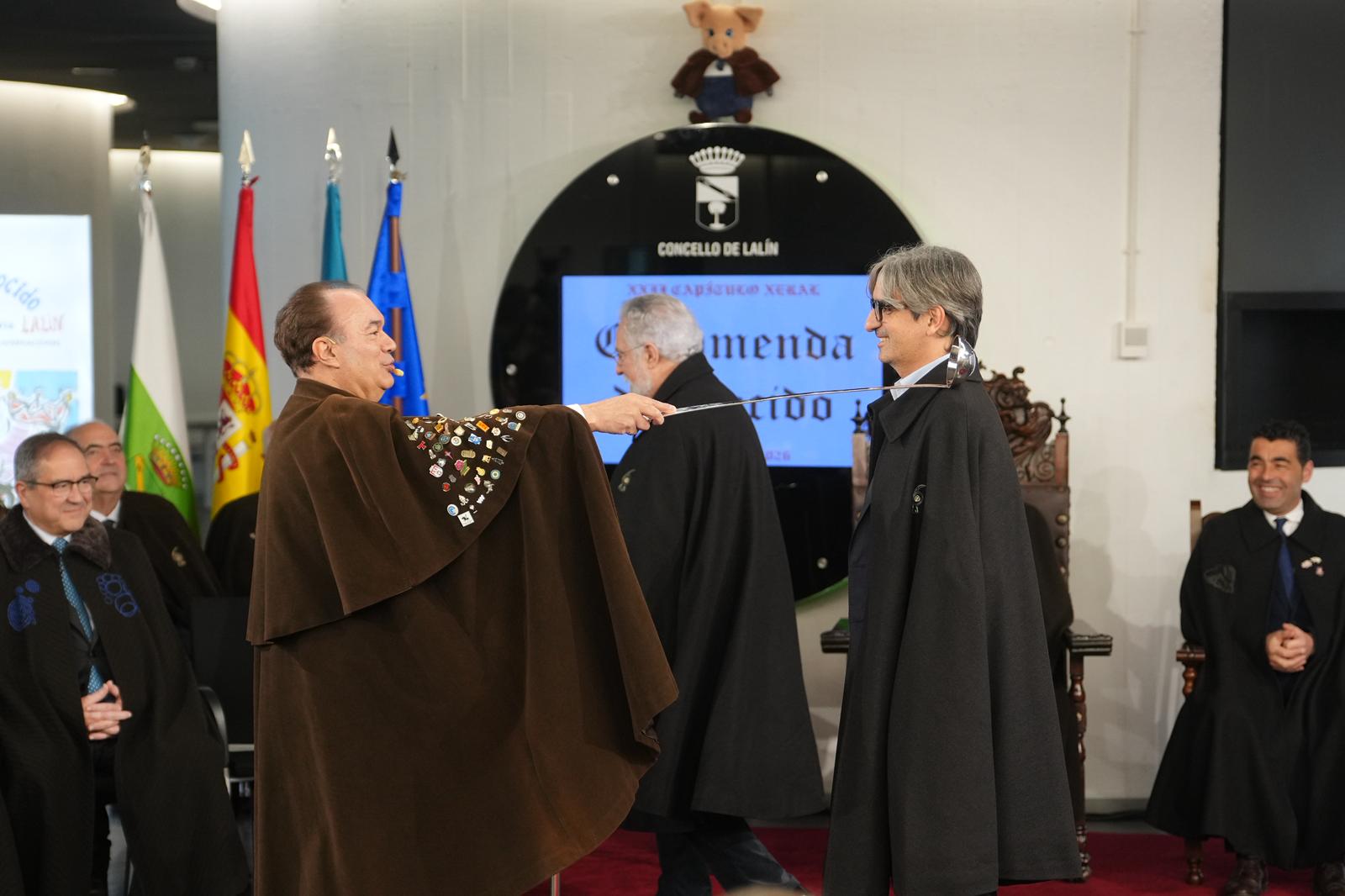
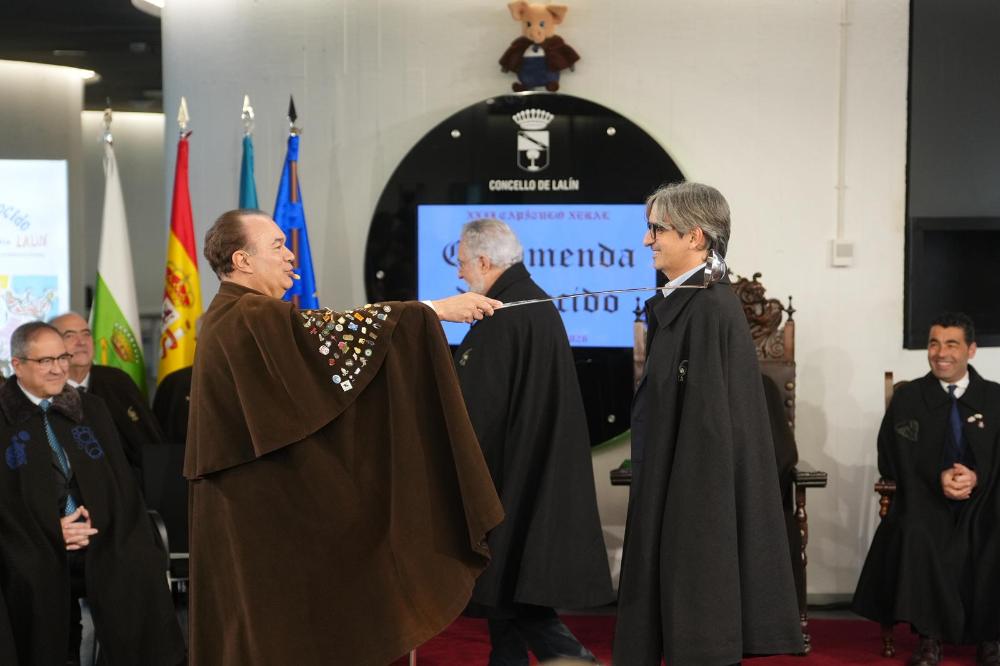
The events of this great day of Cocido began at around 10.30 am in the Town Hall with the Encomienda del Cocido, in which nine new members were inducted this year: Diego González Rivas (town crier, world-renowned Galician thoracic surgeon); Irene Villa (writer, psychologist and leading figure in personal development); Ramiro Mejuto (businessman from Lalín and leading figure in the refrigeration sector); Luis de la Fuente (national football coach); Jorge Mira (physicist, science communicator and winner of the Galicia Research Medal); Almudena Maíllo (Councillor for Tourism at Madrid City Council and Secretary General of the Union of Ibero-American Capital Cities); Antonio Chaves (writer, painter and collector, promoter of the Galician Toy Museum in the Pazo de Liñares -Lalín-); María Martínez Allegue (Regional Minister for Housing and Infrastructure Planning of the Xunta de Galicia) and Valentín García Gómez (Secretary General for Language of the Xunta de Galicia).
Tasting of Lestedo filloas
The delegation, led by the town crier and ambassador, Dr Diego González Rivas, the mayor of Lalín and the president of the Regional Government of Galicia, then visited the Carpa del Cocido in the Campo de la Feria, where they sampled typical gastronomic products and crafts from Lalín. The visit also included a tasting of Lestedo filloas, prepared by members of the Cultural Association of the Filloa de Lestedo, with the participation of residents of Boqueixón, as part of the twinning between the Cocido Fair and the Filloa Festival, which took place in 2025.
The delegation also included: the President of the Parliament and Commander; the President of the Provincial Council of Pontevedra and Commander; several senior officials from the Xunta de Galicia (the Regional Minister for Education, Science, Universities and Vocational Training and Commander; the Regional Minister for Health; the Regional Minister for Employment, Trade and Emigration and Commander; the Xunta's regional representative in Pontevedra; secretaries and directors-general, etc.); the President of the High Court of Justice of Galicia; MEPs; provincial, regional and national deputies; senators; mayors; the Ombudsman; the Director of the Naval School of Marín; the President of the RAGBA; the poster designer for the Fair, José María Barreiro, also a Commander; Commanders; sponsors and members of the Corporation.
The delegation then proceeded to the stage on Calle Principal, where Diego González Rivas gave his opening speech after being introduced by the mayor of Lalín. The president of the Xunta then presented the speaker with a medal. This was followed by a parade of brass bands and dance troupes on a day when the weather is giving us a break. In the afternoon, the Charanga KM Cero brass band will liven up the streets and, at sunset, the Charanga Ardores brass band and the Tekila Orchestra will perform in a marquee set up in the Plaza de la Iglesia.